


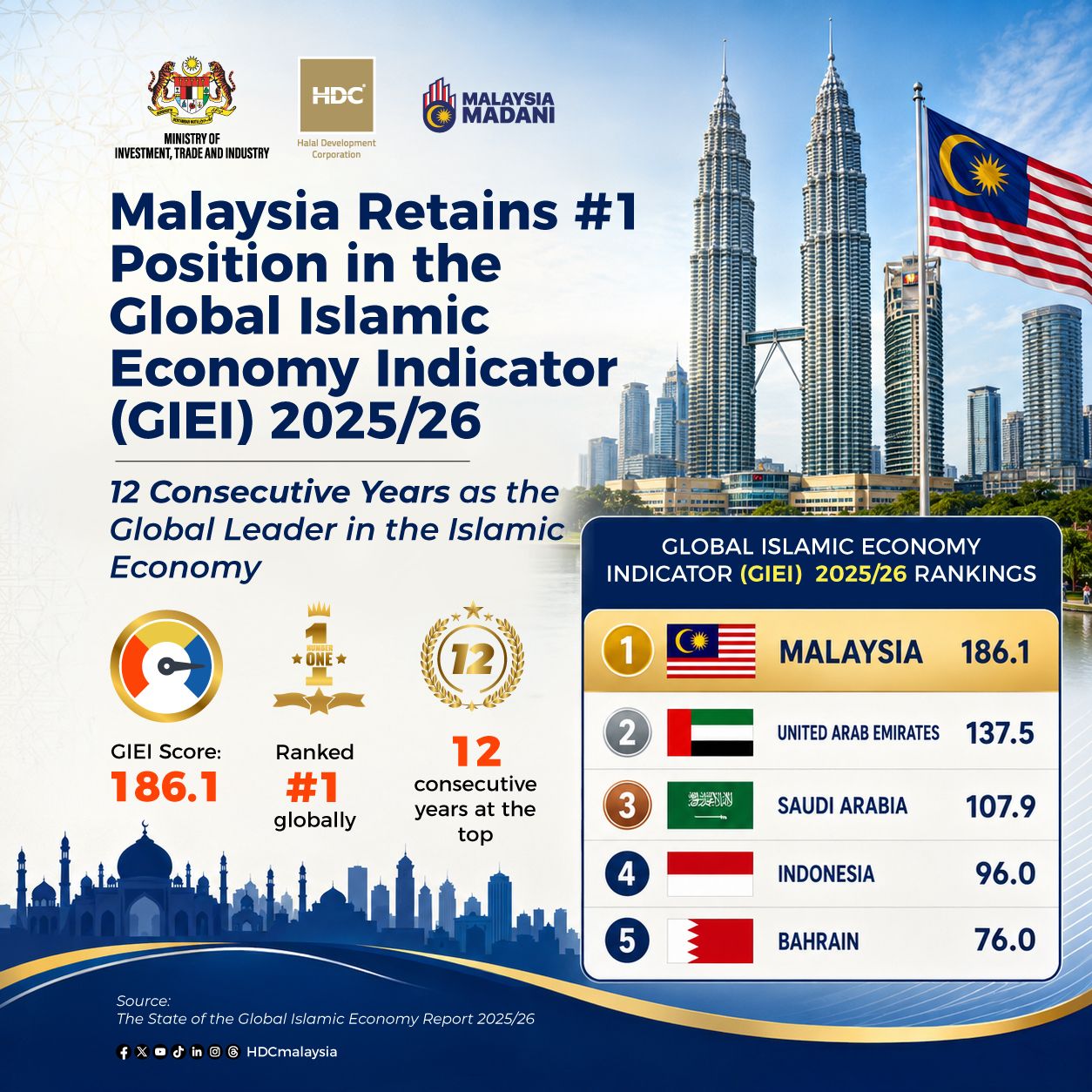
Solidifying its institutional dominance at the absolute apex of global Islamic trade, Malaysia has once again clinched the undisputed No.1 position in the Global Islamic Economy Indicator (GIEI).
According to the newly released State of the Global Islamic Economy (SGIE) Report, the nation has successfully defended its top global ranking for 12 consecutive years, sweeping the first-place positions in critical high-margin verticals including halal food, Islamic finance, and halal pharmaceuticals and cosmetics.
The announcement, highlighted by the Halal Development Corporation Berhad (HDC), an apex agency under the Ministry of Investment, Trade and Industry (MITI), comes at a critical macroeconomic turning point.
As global supply chains fracture under geopolitical tension, international corporate buyers are aggressively seeking high-accountability trade corridors that guarantee regulatory compliance, ethical integrity, and uninterrupted asset flow.
By matching strict shariah compliance with world-class industrial standards, Malaysia has transformed its halal certification framework from a domestic regulatory process into a premium, cross-border commercial moat.
Dissecting the Trade Engine: Capital Inflows and Sub-Sector Dominance
For multinational manufacturers and institutional property funds expanding across the ASEAN-GCC trade axis, the scale of the global Islamic marketplace has evolved beyond a niche demographic play into an essential consumer market.
Global Muslim consumer spending reached a massive USD 2.6 trillion and is on an absolute upward trajectory to hit USD 3.56 trillion by 2029.
Malaysia’s ability to sit at the core of this capital flow is driven by a two-pronged structural framework:
1. High-Velocity Export Architecture
Led by HDC Chairman Prof. Dr. Mohd Afandi Salleh, the nation’s halal infrastructure generated RM68.52 billion in halal exports, representing a spectacular 10.9% year-on-year expansion. This export engine now commands 4.3% of total national exports, with the highest margin gains concentrated in high-demand segments like food and beverages and functional halal ingredients. This established scale positions the country as the preferred entry point for foreign direct investment (FDI) looking to build scalable regional distribution networks.
2. Digital Tech-Stack Integration
To maintain this competitive advantage against regional competitors, Malaysia is rapidly shifting its entire compliance ecosystem onto digital rails. The forward strategy focuses on the immediate deployment of blockchain-enabled traceability, automated digitalisation of halal certification, and advanced Islamic digital finance applications. By replacing manual back-office tasks with automated ledger validation, the ecosystem effectively eliminates customs delays, protects product authenticity, and accelerates trade velocity across major global shipping lanes.
The Diplomatic Moat: Institutionalizing Harmonised Cross-Border Standards
From a corporate strategy perspective, the true long-term security of Malaysia’s top ranking lies in its aggressive focus on halal diplomacy and institutional thought leadership.
In international trade, the lack of uniform standards across different countries acts as a major barrier to expansion, forcing exporters to undergo expensive re-certification processes for every new market they enter.
By taking a lead role in international standardisation platforms, Malaysia is systematically harmonizing certification requirements between ASEAN and the GCC.
This deep institutional alignment allows Malaysian-certified businesses to gain immediate access to foreign markets without facing typical bureaucratic roadblocks.
This unique access shields local producers from unexpected regulatory shifts, turning compliance from an ongoing operational expense into a permanent market advantage.
Source : Malaysian Business